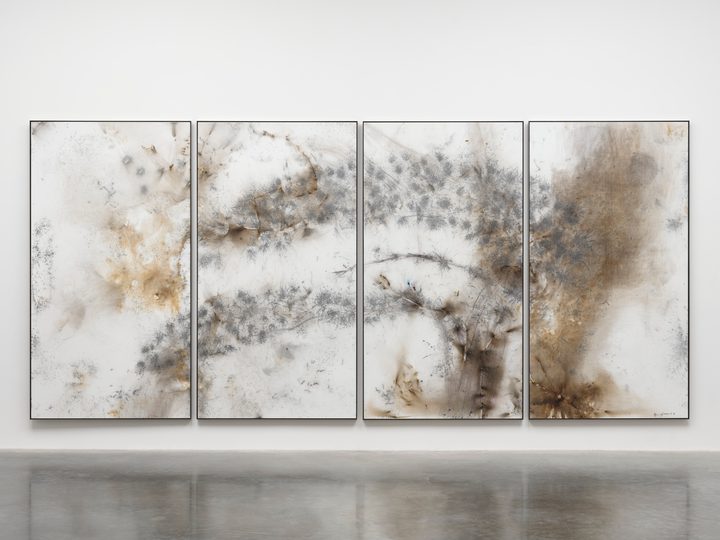
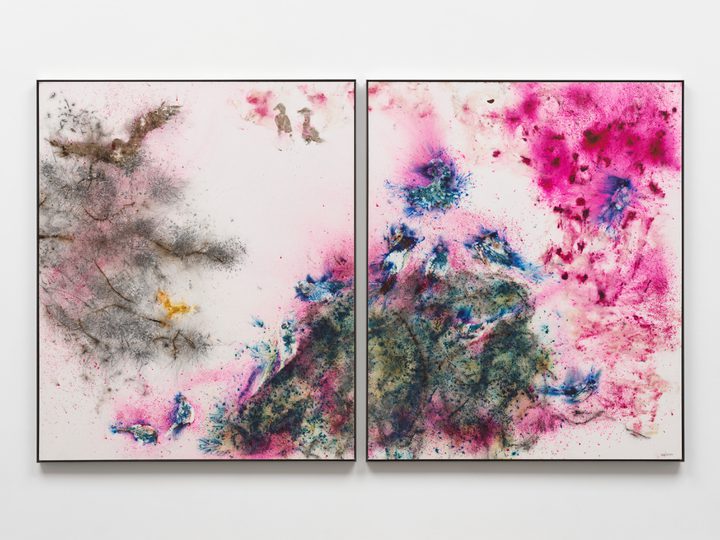
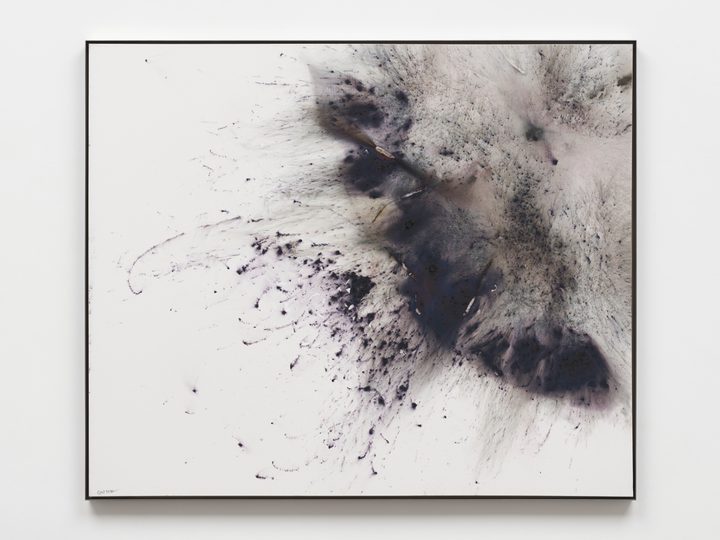
Though perhaps most widely recognised for his pioneering work with gunpowder, the artist’s practice lays claim to an extensive range of methods, encompassing not only pyrotechnic display, but also performance, video, installation and public art, as well as painting and sculpture, for which he draws upon a diverse array of materials: among them traditional Chinese ink, medicinal herbs, limestone, salvaged wood, mirrors and glass, alongside more recent expansions into new technologies, including artificial intelligence (AI), virtual reality (VR), augmented reality (AR), NFTs and blockchain. Gunpowder, however, remains his most enduring and generative medium: a primal substance whose volatile energy underpins many of Cai’s most iconic and celebrated works, and through which he engages his most fundamental philosophical preoccupations. First discovered over a millennium ago by Chinese alchemists in search of an elixir of immortality, gunpowder entered the artist’s practice already laden with inherent paradox: devised for the prolongation of life yet consummated in a moment of violent combustion. In this instant of alchemical transformation, the artist enters a state of heightened receptivity, finding in the medium a unique capacity to give material form to registers that lie beyond the visible world.
Now based in New York, where he has lived and worked since 1995, Cai traces the conceptual roots of his practice to his upbringing in Quanzhou, a port city in China’s Fujian province. The city’s historic legacy as a key point of departure along the Maritime Silk Road has informed a number of the artist’s works, most notably his project for the 46th Venice Biennale, Bringing to Venice What Marco Polo Forgot (1995), which centred around a traditional fishing boat freighted with Chinese herbs alongside other works by the artist. Quanzhou’s close geographical proximity to Taiwan, moreover, left its own distinct impression on the artist, who recalls hearing, as a child, the faint sound of artillery fire carrying across the water, while the city’s prevalence of firecracker workshops ensured the ready availability of gunpowder, and with it the means for his earliest experiments with the medium.
In the early 1980s, Cai studied stage design at the Shanghai Theatre Academy, an experience that fostered an experimental approach and attuned him to the fluidity of time, the use of multimedia materials and the collaborative nature of artistic production. His subsequent relocation to Japan in 1986 proved no less pivotal, bringing his work to the attention of international audiences while also introducing him to modern astrophysics and quantum mechanics, within which he discovered striking resonances with classical Chinese cosmology. These ideas, compounded by the cultural and ideological tensions surrounding Japan’s rapid Westernisation, prompted in Cai a more expansive cosmological enquiry that would, in turn, seed the formation of one of his most enduring bodies of work, ‘Project for Extraterrestrials’. Initiated in 1989, the project comprises a series of large-scale explosion events for extraterrestrials, which have been realised at sites across the globe: from its first iteration in Tokyo (Human Abode: Project for Extraterrestrials No. 1, 1989), to subsequent interventions in Europe, where he exploded Fetus Movement II in the Hannoversch Münden military base in Germany (1992), and the Gobi Desert, where he sought to extend the Great Wall of China by igniting a ten-kilometre trail of gunpowder (1993). After several attempts to realise his early 1990s work Bigfoot’s Footprints: Project for Extraterrestrials No. 6, Cai eventually brought the concept to fruition at the opening ceremony of the 2008 Beijing Olympics, where fireworks traced a sequence of giant footprints of certain extraterrestrial beings across the city’s night sky. This series of explosion events was also accompanied by gunpowder drawings created for each work.
The artist’s gunpowder paintings likewise remain central to his oeuvre, and since his early forays in the medium, his methods have achieved a unique refinement. First mapping the image by sprinkling the powder onto his chosen support, the artist then covers and weighs it down with stones before ignition, such that the blast disperses, recomposes and fuses the matter on the canvas. In recent years, the increasing prominence of colour in his work has opened a more overtly painterly dimension, revealing collisions of sensuous colour from which floral elements and bird motifs emerge. For Cai, the natural world has long been a touchstone: ‘Flowers and plants have often served as my way of portraying that cosmic cycle – nature’s rhythm mirroring the birth and death of the stars’.1
In parallel with these longstanding phenomenological concerns runs another axis of Cai’s recent practice: his correspondence with the Western art canon. From his youth, he has admired El Greco and Cézanne in particular, discerning in their works a shared impulse to render invisible worlds through visible form. As part of his ‘An Individual’s Journey Through Western Art History’, an ongoing project initiated by Cai in 2017 and comprising a series of solo exhibitions and one exhibition he co-curated, the artist has engaged with different periods in Western art history as represented by the museums’ collections, giving rise to bodies of work including his ‘Pompeiian Liaison’ series of gunpowder paintings, which emerged from an explosive intervention staged in Pompeii in 2019, and his ‘Study for Uffizi’ series (2018), which renders the silverpoint techniques of the Renaissance into the scorched impressions of gunpowder.
Cai describes gunpowder as an ‘ancient alchemical technology’, an instrument that, like its modern technological counterparts, demands both human discernment and a willingness to relinquish control. ‘This oscillation between control and freedom’, he states, ‘has become the very essence of my practice’.2 In recent years, the artist has continued to experiment with digital technologies, deploying drone fleets to choreograph his fireworks into precise formations that inscribe images and text across the sky, while also working with virtual reality, most notably in Sleepwalking in the Forbidden City (2020), which situates the viewer within an immersive imagined fireworks display over the imperial palace.
It is within this spirit of enquiry that artificial intelligence has come to occupy an increasingly central role in his practice. The artist’s custom-built AI model, cAI™, developed since 2017, has become an active collaborator and interlocutor in the realm of metaphysical spirituality. cAI™ is capable of generating source imagery for his paintings, conceptualising and directing his firework displays, providing narration for his performance works, and enabling him to explore more speculative, spiritual modes of engagement. As his engagement with AI advances, the artist has expressed a desire to explore an unprecedented ‘AI-ness’ that situates itself ‘beyond the human – something in a league of its own’.3 The future of Cai’s work remains, by its very nature, open and uncertain: orientated, as it has always been, towards rendering the unseen visible, yet undoubtedly venturing further still towards what lies beyond the threshold of the conceivable.
Cai Guo-Qiang (b. 1957, Quanzhou, China) has lived and worked in New York since 1995. In the early 1980s he trained in stage design at the Shanghai Theatre Academy, China, and from December 1986 to September 1995, he sojourned in Japan for nearly nine years, during the initial phase of which he studied at Tsukuba University in the Plastic Art and Mixed Media research lab. Notable international solo exhibitions include the Palace Museum, Beijing (2020); National Archaeological Museum of Naples and the Archaeological Park of Pompeii, Italy (2019); Uffizi Galleries, Florence, Italy (2018); Museo Nacional del Prado, Madrid (2017); Pushkin State Museum of Fine Arts, Moscow (2017); Solomon R. Guggenheim Museum, New York (retrospective, 2008); and The Metropolitan Museum of Art, New York (2006). He has received numerous awards, including the Golden Lion at the 1999 Venice Biennale, the Hiroshima Art Prize in 2007, and the 2009 Fukuoka Prize. In 2012, he was honoured as a Laureate for the prestigious Praemium Imperiale, in the painting category. The same year, he was named as one of five artists to receive the first US Department of State Medal of Arts for his outstanding commitment to international cultural exchange.
1 ‘Cai Guo-Qiang in conversation with Hans Ulrich Obrist’, Cai Guo-Qiang: Gunpowder and Abstraction 2015–2025, exh. cat., White Cube, 2025, p.12
2 ‘Cai Guo-Qiang in conversation with Hans Ulrich Obrist’, Cai Guo-Qiang: Gunpowder and Abstraction 2015–2025, exh. cat., White Cube, 2025, p.13
3 ‘Cai Guo-Qiang in conversation with Hans Ulrich Obrist’, Cai Guo-Qiang: Gunpowder and Abstraction 2015–2025, exh. cat., White Cube, 2025, p.19