Born in 1957 in Crownpoint, New Mexico, Whitehorse grew up near Chaco Canyon – a major archaeological site that was once the centre of Ancestral Puebloan civilisation. Her nomadic childhood alternated between summers at Whitehorse Lake – named for the white horses her family kept, which would gather at the lake to drink – and winters in the shadow of Mount Taylor (Tsoodził), a sacred Navajo site. Surrounded by Ancestral Puebloan ruins, fossils, and shards of pottery, these early encounters with archaeological and natural phenomena shaped an artistic lexicon that would distil this landscape into a distinctive symbology, registering both the minute flurries of life and the vast cosmological and seasonal cycles.
Initially experimenting with clay, metal and wood as a student, Whitehorse eventually settled on drawing and painting as her primary media. Studying at the University of New Mexico, she received a BA in Painting in 1980, followed by an MA in Printmaking in 1982. It was during this period that she met the late Jaune Quick-to-See-Smith, with whom she co-founded the Grey Canyon Group – a Native American artist collective established in 1977 that challenged prevailing stereotypes of Indigenous-made art. Formed in response to systemic underrepresentation within the art department, the group asserted a space for Native American art within contemporary discourse, resisting its reduction to traditional craft practices. Alongside this, the feminist art movement of the early 1970s offered Whitehorse a formative point of reference, in particular the work of Miriam Schapiro and Harmony Hammond. Their abstract assemblages and sculptural works, which expanded the terms through which materials and practices long circumscribed as ‘craft’ might operate within a fine art context, resonated with Whitehorse’s own approach to expressing her cultural heritage through a unique visual language.
Taking her lead from her environment, Whitehorse imbues each painting with a distinct palette, weaving together evocations of natural phenomena – dust billowing across open plains, the arrival of rain, the germination of a seed pod. In Kin Náh Zin II (1983) and Rincon Marquez II (1986), created during her years living in Connecticut in the 1980s, the atmosphere of Whitehorse’s compositions assumed a claustrophobic character, registering a profound dissonance with her stifling urban environment at the time. In works made during this period, larger, flatter motifs are compressed within the picture plane, pushed towards the viewer, their forms jostling for space in visual analogue to the overwhelming presence of buildings, roads and people. Her return to the Southwest in 1987 marked a pivotal shift and heralded a compositional expansiveness, conveying a measured and reverent observation of a quietly changing land through a renewed sense of balance.
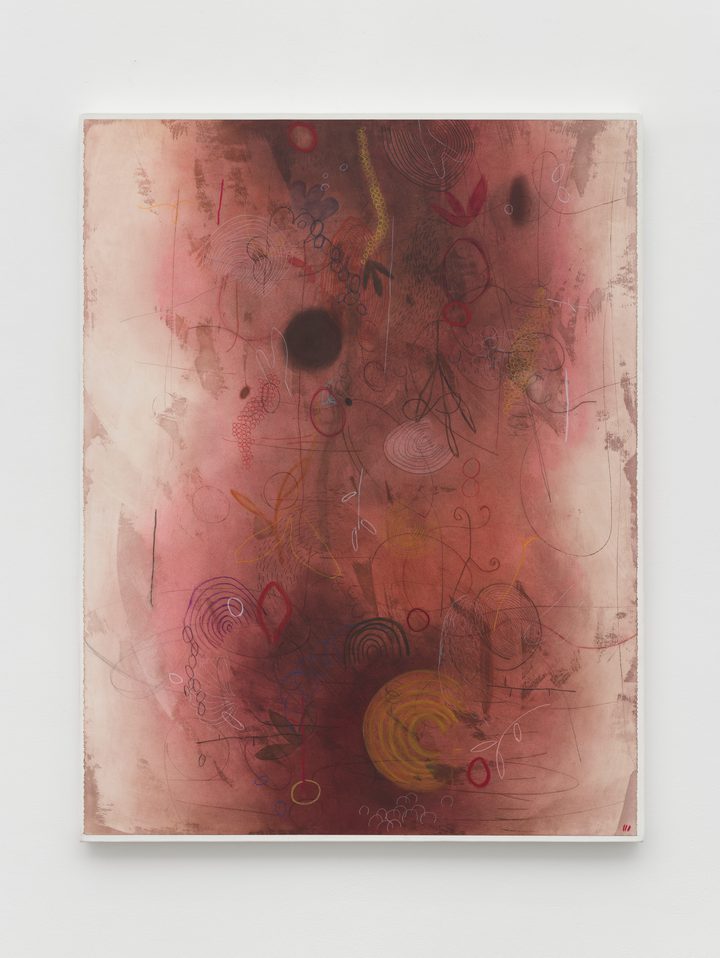
In the years following her return, Whitehorse refined the visual language that has come to define her mature practice. Embedded within Navajo culture is the art of weaving, which, according to oral tradition, encapsulates a moment of creation: one in which the loom figures as a convergence of earth and sky. In her paintings, Whitehorse translates the structural and material complexity of weaving into compositions that possess the optical intrigue, technical virtuosity, and cultural resonance of a deftly woven Navajo rug. Working from atmospheric grounds of vaporous oil wash, she builds intricate symbolic configurations in Conté pencil, pastel and chalk, layering and interlacing precise, linear forms across the surface. Echoing the illusory geometric rugs she watched her grandmother weave, these forms draw in part from her family’s weaving tools: combs and bowls that become glyphic elements within her pictorial vocabulary.
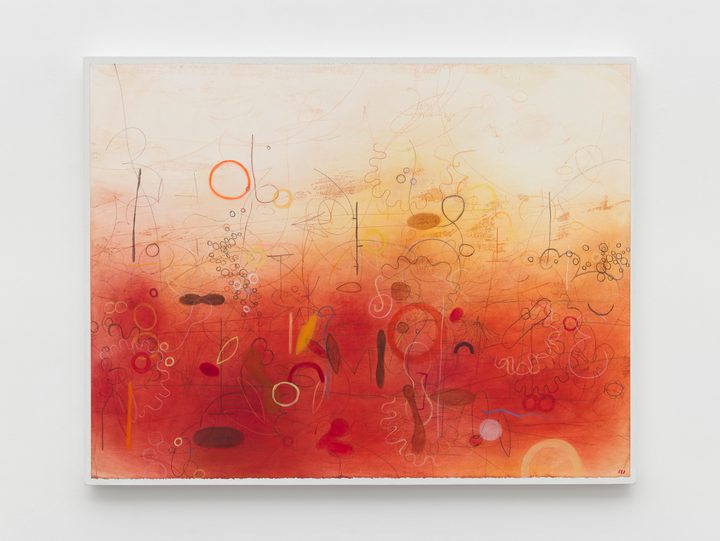
Throughout the 1990s, Whitehorse developed a palette and methodology rooted in reciprocity with the land. Rich ochre, ecru-blush, and chalky terracotta shades consistently dominate her palette, distilling the sensibilities of the land into each work. In Tsin Tah II (Amidst Forrest) (1992) and Sandstone (1998), earthy tones prevail: burnt amber and aubergine dissolve into pale ivory, charting the sun’s passage as its light bleaches and flattens the landscape at noon. Within these compositions, organic motifs bring into relation vast geological spans and the minute precision of a seed pod poised to burst. Elements such as pollen, air and fossils operate as compositional fragments that bind the microscopic and the monumental across the pictorial surface.
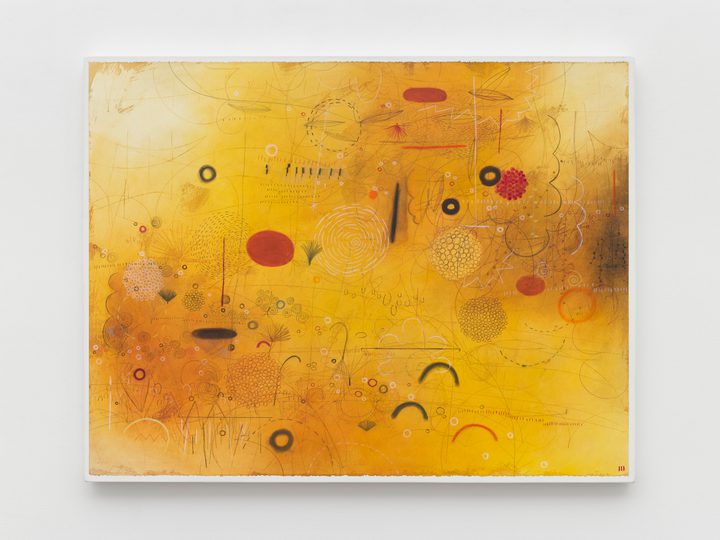
Holding artistic admiration for the Colour Field abstractions of Mark Rothko and the sensuous draughtsmanship of Hans Bellmer, Whitehorse’s compositions formally coalesce these influences, though she draws her creative wellspring foremost from the land. ‘Landscape was what I knew best. My backyard’1, the artist notes, which she approaches in a spirit of reciprocity and balance, rather than extraction. This ethos echoes hózhó, the Navajo philosophy of ‘walking in beauty’ – maintaining harmony through the continual practice of balance. In Dream Site (2016), the vast, arid plains of Chaco Canyon are called forth through a diaphanous wash of ochre, upon which abstract organic motifs – suggestive of birds, sheep, and dried plants – hover and interlace across the pictorial field, evoking the land’s topography and seasonal rhythms.
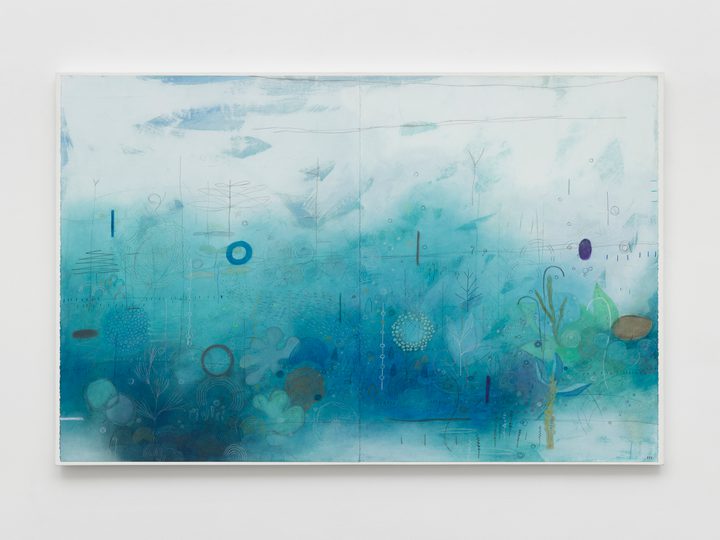
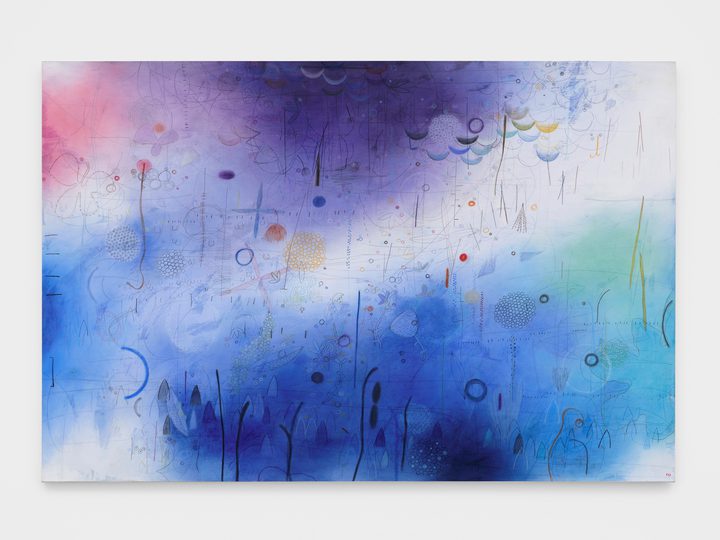
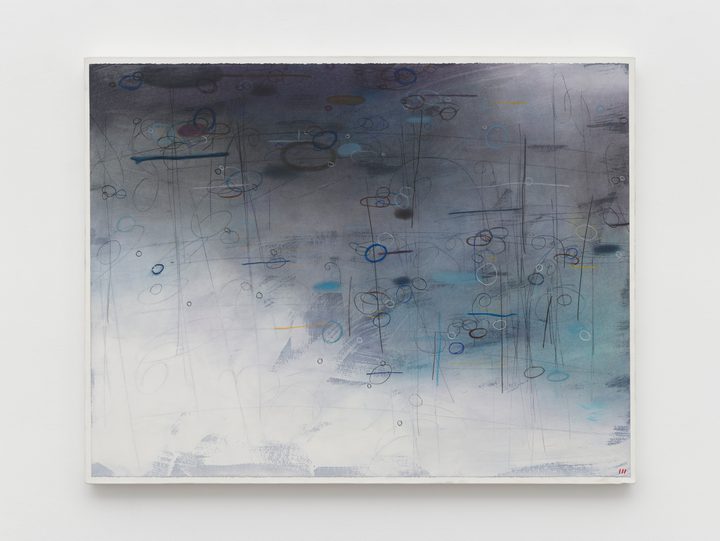
In more recent work, including Shallows (2025) and Father Sky meets Mother Earth (2025), Whitehorse turns her attention skywards. In the former, the painting’s azure hue gestures not to water as its title might suggest, but to the open sky above. The title instead alludes to a longing for water – an element held sacred by the Navajo in all its forms, from mist and fog to rain. Father Sky meets Mother Earth, by contrast, captures the passage of a distinctive frontal cloud formation, the drifting convergence of cool, darkened blues and warm violet-pinks holding together a sense of foreboding encroachment and mothering embrace. Approaching each composition with paper laid out flat, Whitehorse’s process remains intuitive, corralling the forces of the natural world into deftly structured compositions that allow the land to speak.
Rooted in the entangled histories of human and non-human life, Whitehorse’s paintings offer a counterpoint to the traditions of landscape painting, foregrounding a relationship of reciprocity rather than the extractive gaze long associated with the genre. Through her destabilisation of spatial depth and measured observation of the environment, Whitehorse’s work operates as a form of spiritual cartography, alive to patterns of movement and to intangible connections across time and place. Charting these connections over time, her work unfolds as an ongoing meditation on what we owe to the earth that sustains us.
Emmi Whitehorse (b. 1957, Crownpoint, New Mexico) lives and works in Santa Fe, New Mexico. She is an enrolled member of the Navajo Nation. Whitehorse received a BA with a Major in Painting in 1980 and an MA with a Major in Printmaking in 1982 from the University of New Mexico. Solo exhibitions of her work have been held at the Wheelwright Museum of the American Indian, Santa Fe, New Mexico (2026); Boulder Museum of Contemporary Art, Colorado (2006); Joslyn Art Museum, Omaha, Nebraska (2001); and the Tucson Museum of Art, Arizona (1997). Whitehorse's work has been featured in group exhibitions that include The 60th International Art Exhibition of La Biennale di Venezia, Venice, Italy (2024); Whitney Museum of American Art, New York (2024); and the National Gallery of Art, Washington, DC (2023).
1 Emmi Whitehorse, quoted in
The Land Carries Our Ancestors: Contemporary Art by Native Americans, exh. cat., National Gallery of Art and Princeton University Press, 2023, p.132