
TARWUK
Mit dem Frosch zu schmusen, ist es unmöglich.
9 July – 15 August 2026
Text by writer and cultural theorist Ana Teixeira Pinto.
TARWUK, composed of Bruno Pogačnik Tremow and Ivana Vukšić, is not an artist duo in the conventional sense. The artists describe their collaboration as a ‘condition’ – a chosen state of existence that prioritises process over product, dissolution over fixed identity, and relation over singular authorship. Central to TARWUK’s practice is the concept of theatre – not as spectacle or illusion, but as a methodology for aesthetic expression. The performative dimension does not require literal motion; rather, it inheres in the work’s relational instability.
Where classical sculpture asserts itself as a finished object occupying a defined space, TARWUK’s installations operate more like a transient or provisional stage set – assembled from discarded parts, contingent and perpetually subject to rearrangement. This theatrical vocabulary deliberately counters the language of sculptural stasis, which traditionally privileges material endurance, fixed form and immutable presence. By contrast, TARWUK embrace the fragment, the salvaged, the oddity and the discontinuous. Consequently, this approach leaves their practice fundamentally un-settled – refusing any single, stable reading or categorical resolution. More pointedly, it makes the work deeply un-settling for the audience, who are denied the comfort of passive observation and instead implicated within a fractured, mutable visual field that actively resists closure.
Installed in the ground floor gallery, the assemblage – what TARWUK refer to as a ‘harmonic percolator’ – actively engages the surrounding space, its meaning shifting with the viewer’s position and proximity, and their willingness to linger in uncertainty. The assemblage is bookended by two monitors – the first shows 13 Films (2026), a reel of 13 one-minute videos shot on the occasion of the new and full moons in 2024, while the second features a conversation piece in which Tremow and Vukšić discuss their ever-evolving collaboration as existing downstream from drawing, the joint practice always at hand, the locus of their nomadic artistic existence, and the medium that travels with them when nothing else can. Their ‘harmonic percolator’ refuses to settle into legibility, less an object to be deciphered than a field of potential, unfolding anew with each encounter.
In the gallery space underground, directly beneath the installation, TARWUK present paintings with refined, oneiric figures that frequently evoke the illustrative sensibility of Aubrey Beardsley. Like Beardsley’s, TARWUK’s works can be read as theatrical tableaux: figures performing for an unseen audience – each composition staging its subjects in heightened, artificial poses that imply a narrative unfolding just beyond the frame. The resulting aesthetic incongruity – the Beardsleyan languor of the paintings set against the Dadaist aggression of their installation – emphasises the state of tension their entire practice is built upon. One could construe this opposition as not merely stylistic but relational. The paintings hold the viewer at a distance, inviting a gaze that is contemplative, passive, almost voyeuristic. The installation, by contrast, draws the viewer in, breaking the fourth wall; it’s demanding, confrontational, and it offers no comfort, nor does it console.
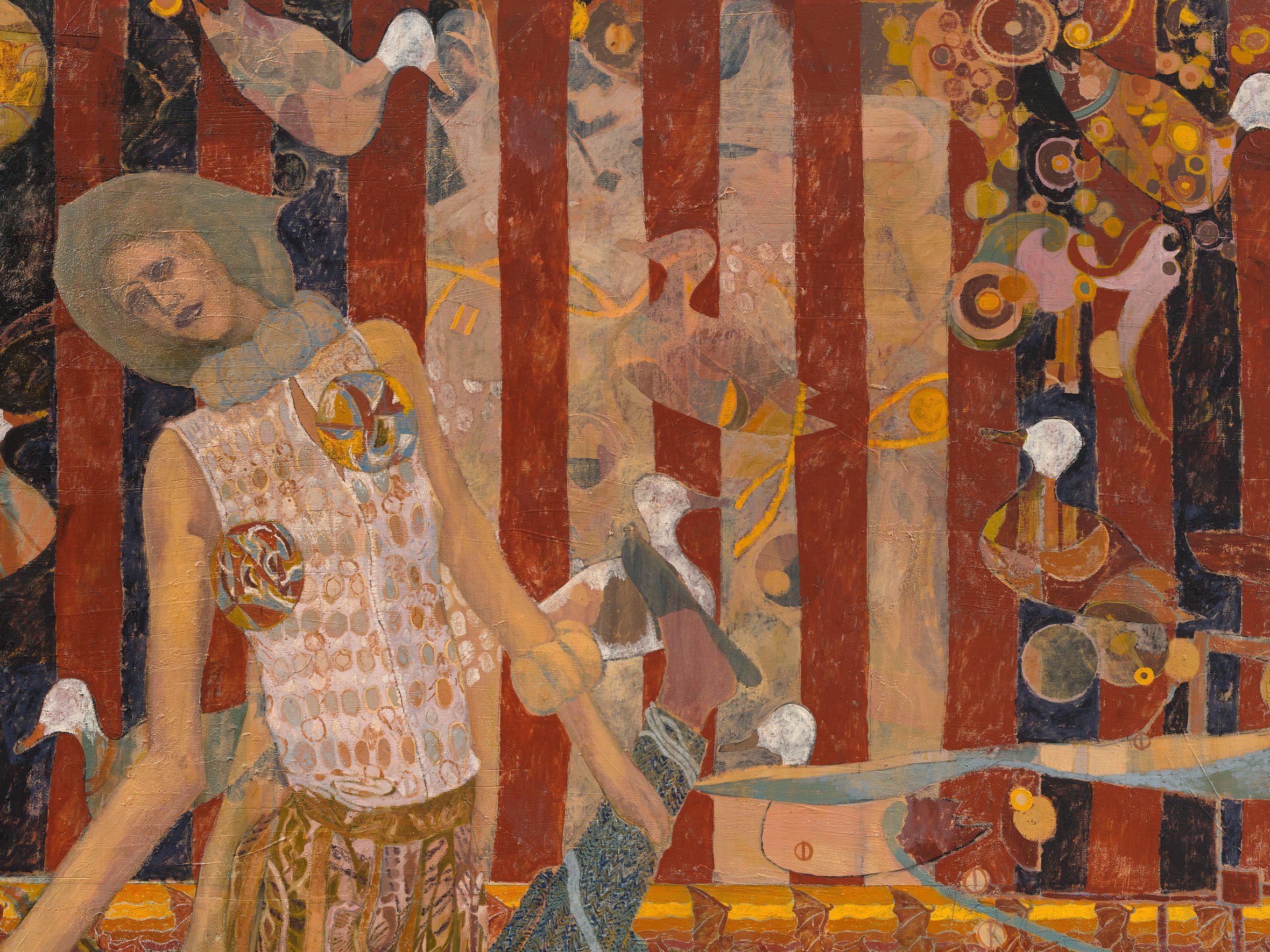
Coming of age just as Croatia tore itself from the Yugoslav federation, TARWUK navigated the tumultuous years of charred farmlands, violently revised borders and the indelible trauma of ethnic purges. This shared history informs the bleak undercurrents in their work, expressing itself in disfigured figures that translate the abstract devastation of war into tangible, physical form. Their palette was previously one of organic decay – the off-whites, dirty browns and ashen greys of aged, biological matter. The lack of vibrant colour made their figures often feel archaeological, unearthed. But where their paintings once adhered to this muted, subdued palette, the present exhibition admits a vivid hue into their vocabulary with the two-panel piece, MRTISKLAAH_wonK_ot_ycnegrU_gnisserP_ehT (2026), anchored by an imposing orange swath. The orange paint itself carried its own history – it came from the studio of the late American painter Ron Gorchov, whose widow had allowed them to use the space and act as custodians. They had moved that paint with them across various studios in New York, holding onto it as a memory of him, until it finally found its purpose in this work. As they stepped back to survey their new work, the distance from their familiar vocabulary became undeniable. TARWUK also realised that, for the first time, their work was depicting an actual place – specifically, the small village where their family still lives and where they return to each year. With this newfound awareness, they approached the second painting – MRTISKLAAH_diuqiL_ykliM_htiW_delliF_raJ_a_ni_yrotsiH (2026), which shows two surrogates lying down in the bay – as an experiment to test how a connection to a real location would influence the work, believing that knowing the subject’s real-world reference would introduce an entirely different level of engagement.
By contrast, MRTISKLAAH_segaugnaL_llamS_nistcejbuS_giBtuobA klaT_naC_uoY (2026) originated not from reality but from a dream; Ivana woke up one morning and told Bruno she had dreamt the painting. Bruno insisted they make it. Translating a dream into a physical artwork proved challenging, however. Bruno initially painted the water blue, but Ivana pushed back, arguing that since swans inhabit a lake, the water had to be green. They repainted it green, yet this adjustment disrupted the upper part of the composition. Perplexed but determined, they added more green. This dream-painting – a vision of a place that does not exist – is poised alongside the artists’ home village, also documented in 13 Films. The dispute over colour (blue versus green) can be read as a collision between the actual and the imagined: precisely the dialectic of exile.
The swan was introduced to Europe not as wild bird but as living luxury good – an object of status, an ornament for the elite or a royal prerogative. A creature of exquisite beauty entangled with themes of eroticism, decay and tragedy, the swan appears often in Symbolist art and poetry. Aubrey Beardsley’s 1896 drawing Bathyllus in the Swan Dance turns the myth of Leda and the Swan into a vehicle for theatrical excess. In the sonnet Le vierge, le vivace, et le bel aujourd’hui, Stéphane Mallarmé places the swan on a frozen lake, forgotten under frost as a ‘Phantom whose own pure radiance assigns this place, / He is immobilised in the cold dream of scorn / That by the way is through his useless exile worn.’1 Unlike Odysseus, whose exile was a journey toward return, Mallarmé’s swan has no destination, no hope of reintegration, and no audience for its tragedy. The exile is ‘useless’ because it serves no redemptive function – it does not teach, transform or lead anywhere. The ‘horror of the earth’ suggests that the ground beneath it is not his home but his tomb.2
In Charles Baudelaire’s poem ‘The Swan’ from the collection Les Fleurs du Mal (1857), the swan becomes the perfect emblem for exile and creative impotence – a creature of water forced onto dry, Haussmannian pavement, with ‘nervous wings’ bathing in the dust of city streets.3 Every new building in Paris triggers a vision of what was destroyed, turning the act of walking through the city into an archaeological excavation of grief. There is no escape upward and the swan, violently wrenched from its element, cannot soar to the skies. It is certainly not a coincidence that the swan appears in a dream-painting within an exhibition where, for the first time, TARWUK depict their real home village. By giving in to longing, the swan becomes the catalyst and the condition to unlock a new, hyper-coloured dreamscape – not just a subject but a mechanism that forces the artists to abandon their established identity as makers of muted, chiaroscuro figures and enter an uncomfortable, alien chromatic territory.
In the first of 13 Films (2026) TARWUK stage a vision in which the viewer is offered a drone’s perspective hovering over an unseen target, spliced with the sound of asthmatic, laboured breathing. The effect is one of being hunted, breathless, unable to draw air. Aerial surveillance is rendered visceral. The second minute-long film in the reel, shot as a negative image, tells us that a frog does not know it was once a tadpole – that it is unaware it can develop into an organism wholly unlike its progenitors, before abruptly and conspicuously moulting into its mature biology. One can have no legs, then acquire them. The frog is here a liminal being whose morphology stands at the threshold between two different identities, or at the intersection of different worlds.
Its jelly-like, amphibian body possesses what Tom Gunning has described as ‘the mythical potential of moving between species’, a notion that reappears in another one-minute film, where the artists describe a fantasy of over-eating to the point of inflating like balloons and floating out the window. Together, these works offer a portrayal of the protean body – ‘a fantasy of metamorphosis, change, and mutability unconfined by the forms of actuality’ – that breaks with conventions of plasticity to carry the quixotic promise of a ‘transformation that could be undergone by all’,4 if not politically, then somatically. If transmogrified form and the metamorphic have long been tethered to the withdrawal of the Pre-Raphaelites and Symbolists, here they pivot toward a different register – one where the evasion of formal closure becomes a rehearsal of intimacy. Cuddling a frog is not impossible, but it is unrewarding – its cool, slippery body offers no reciprocation.
Writer biography Ana Teixeira Pinto is a writer and cultural theorist. She is a professor of Art Theory and Digital Cultures at HGB Leipzig and the editor of the Sternberg Press book series ‘On the Antipolitical’. Her writings have appeared in publications such as Third Text, Afterall, e-flux journal, Hyperallergic, Ibraaz, Artforum and Berlin Review. She co-organised HKW Berlin’s ‘The White West’ conference and podcast series, and co-edited the subsequent publication Fascism, Unreason and the Paradox of Modernity (2024, Sternberg Press and The MIT Press). Her forthcoming publication is Death Wall: Entropy and the Chronopolitics of Modernity.
1 Stéphane Mallarmé, ‘Le vierge, le vivace, et le bel aujourd’hui’ (1887), trans. Ryan Wilson, in Literary Matters, 18, no.1, July 2025
2 The line from Mallarmé’s poem reads: ‘The horror of the earth in which his plumes are caught.’
3 ‘And near a waterless stream, the piteous swan / Opened his beak, and bathing in the dust / His nervous wings, he cried (his heart the while / Filled with a vision of his own fair lake)’, Charles Baudelaire, ‘The Swan’, in The Poems of Charles Baudelaire, trans. F.P. Sturm, The Walter Scott Publishing Co., 1906
4 Tom Gunning, ‘The Transforming Image: the Roots of Animation in Metamorphosis and Motion’, in Suzanne Buchan (ed.), Pervasive Animation, Routledge, 2013, p.66
Installation Views


Watch
In the Gallery:
TARWUK
In this film, TARWUK reflect on collaboration as an evolving process, discussing Harmonic Percolator (2026) as a manifestation of their practice while exploring the relationship between installation, painting, drawing and the viewer.
Featured Works

TARWUK
MRTISKLAAH_segaugnaL_llamS_ni_stcejbuS_giB_tuobA_klaT_naC_uoY, 2026


TARWUK
MRTISKLAAH_yrotsiH_detarraN_semoceB_htaerB_eht_erofeB_tnemoM_A, 2026

TARWUK
MRTISKLAAH_diuqiL_ykliM_htiW_delliF_raJ_a_ni_yrotsiH, 2026

About TARWUK
TARWUK were born in 1981 in Zagreb and Dubrovnik, Croatia respectively and live and work in New York. They have exhibited internationally, including solo exhibitions at the Salon Galić, Split, Croatia and Cultural Centre, Osijek, Croatia (2025); Halle für Kunst Steiermark, Graz, Austria (2023); Collezione Maramotti, Reggio Emilia, Italy (2021) and Museum of Fine Arts, Osijek, Croatia (2017). Their work has been included in numerous group exhibitions amongst which are MO.CO. Montpellier Contemporain, France (2024); Lafayette Anticipations, Paris (2023); Kim? Contemporary Art Centre, Riga (2023); Frye Art Museum, Seattle, Washington (2022); Kunsthalle Wichita, Kansas (2021); and the Drava Art Biennale, Osijek, Croatia (2020).
Visit Artist PageNEW RELEASE | NOW AVAILABLE
TARWUK
Purchase two newly released stone lithographs by TARWUK, available individually and as a set.
Create an Account
To view available artworks and access prices.